Quickstart
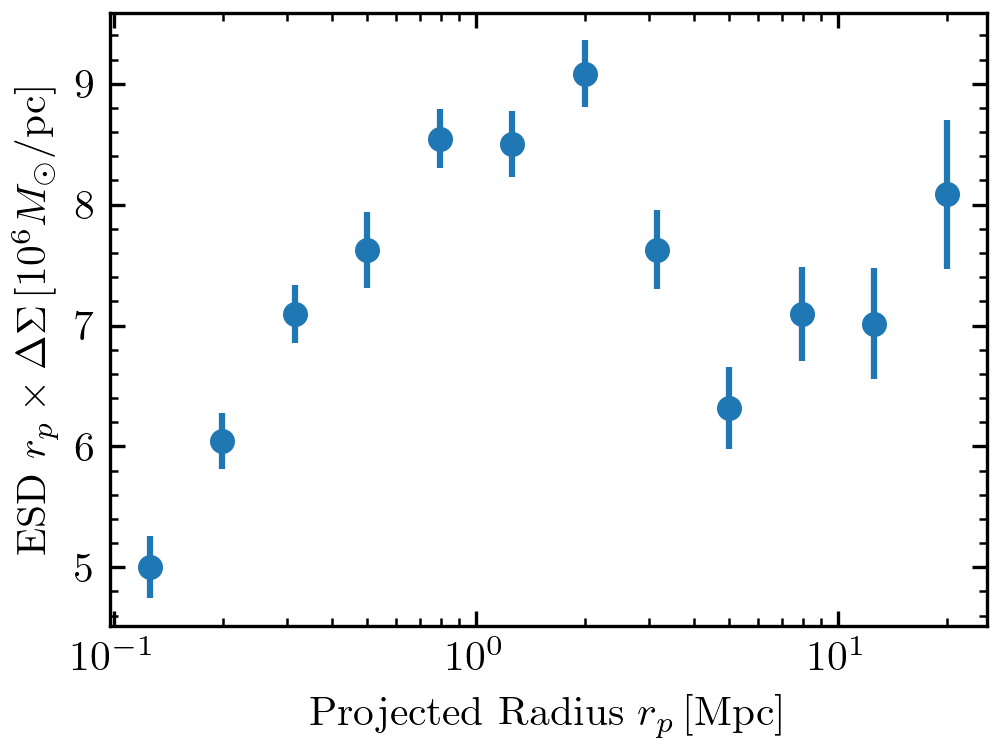
In this quick example, we will calculate the lensing amplitude around galaxies in BOSS in the redshift range \(0.2 < z_l < 0.4\). Let’s use the publicly available DECADE catalog for this task (see DECADE Shape Catalog).
import matplotlib.pyplot as plt
import numpy as np
from astropy.table import Table

from dsigma.jackknife import compute_jackknife_fields, jackknife_resampling
from dsigma.precompute import precompute
from dsigma.stacking import excess_surface_density

# Import lenses and cut to redshift range.
table_l = Table.read('galaxy_DR12v5_CMASSLOWZTOT_North.fits.gz')
for key in ['Z', 'RA', 'DEC']:
    table_l.rename_column(key, key.lower())
table_l['w_sys'] = 1
table_l = table_l[(0.2 < table_l['z']) & (table_l['z'] < 0.4)]

# Load source galaxies and their redshift calibration.
table_s = Table.read('decade_ngc.hdf5', path='catalog')
table_n = Table.read('decade_ngc.hdf5', path='calibration')

# Run the expensive precomputation.
rp_bins = np.logspace(-1, 1.4, 13)
precompute(table_l, table_s, rp_bins, table_n=table_n, progress_bar=True)

# Calculate the signal.
kwargs = dict(scalar_shear_response_correction=True,
              matrix_shear_response_correction=True)
results = excess_surface_density(table_l, return_table=True, **kwargs)

# Calculate errors using jackknife resampling.
compute_jackknife_fields(table_l, 100)
results['ds_err'] = np.sqrt(np.diag(jackknife_resampling(
    excess_surface_density, table_l, **kwargs)))

# Plot the results.
plt.errorbar(results['rp'], results['rp'] * results['ds'],
             yerr=results['rp'] * results['ds_err'], fmt='o', ms=5)
plt.xscale('log')
plt.xlabel(r'Projected Radius $r_p \, [\mathrm{Mpc}]$')
plt.ylabel(r'ESD $r_p \times \Delta \Sigma \, [10^6 M_\odot / \mathrm{pc}]$')
For more details, refer to the workflow and application pages.